


Tuesday 8th September 2026
Complete the handwriting assessment in the back of your English book.
08.09.26
Handwriting Baseline
1. Alphabet formation
Write the lowercase alphabet from memory in your usual handwriting.
________________________________________________________________________________________________________
________________________________________________________________________________________________________
Now write the capital alphabet from memory.
________________________________________________________________________________________________________
________________________________________________________________________________________________________
2. Number formation
Write the numbers 0–9 in order.
________________________________________________________________________________________________________
3. Copying task
Copy this passage in your usual handwriting. Write as you normally would in your English book.
On Saturday morning, Maya looked through the window and noticed something unusual in the garden. Beneath the old apple tree was a small wooden box. She hurried outside to investigate. When she lifted the lid, she could hardly believe what she had found.
________________________________________________________________________________________________________
________________________________________________________________________________________________________
________________________________________________________________________________________________________
________________________________________________________________________________________________________
________________________________________________________________________________________________________
________________________________________________________________________________________________________
4. Independent writing
Write for 3 minutes about a place you would really like to visit. Explain where it is, what you would do there and why you would like to go.
________________________________________________________________________________________________________
________________________________________________________________________________________________________
________________________________________________________________________________________________________
________________________________________________________________________________________________________
________________________________________________________________________________________________________
________________________________________________________________________________________________________
________________________________________________________________________________________________________
________________________________________________________________________________________________________
________________________________________________________________________________________________________
________________________________________________________________________________________________________
________________________________________________________________________________________________________
________________________________________________________________________________________________________
Tuesday 8th September 2026
LC: to use the first three or four letters of words to find their meaning in a dictionary
Grammar Warm Up
LC: to create sentences with fronted adverbials
Fronted adverbials give extra information to a sentence and always come at the start (the front) of the sentence.
They give information about
when
how
where
why
something is happening.

When Finn MacCool saw the size of the Scottish giant, he ran away.
As the dragon was causing so many deaths, George came to slay it.
Before the clock struck twelve, we got ready to go to lunch.
Create two sentences using fronted adverbials.
Before
All of a sudden
When
After
Since
As

How do we use a dictionary to find the meaning of a word?

Tell your talk partner.


Use a dictionary to find the words on your list.
Use the semantic word map to record your findings.

These words are from the new legend we are about to read.
What do you think will happen in the story?
Group A words

Group B words

Adapted:
LC: Proofread to check for errors in punctuation.
Task: Each sentence has one punctuation mistake. Find it and correct it.
- george was a brave knight.
- George rode to the town
- The dragon was very scary.
- The dragon had sharp claws huge wings and a long tail.
- The people cheered?
08.09.26
Complete a star maths assessment.

Tuesday 8th September 2026
LC: to use my understanding of timelines to know when the Ancient Greek civilisation existed.


What do you know about the Ancient Greeks?
When did they live?
Where in the world did they live?
How did they live?
Do you know any Greek myths?
Can you name any Greek islands?

Tell your talk partner.
Click on the image below to learn more about the Ancient Greeks.

Now, tell your talk partner what you have learned about the Ancient Greeks.

Let's look at when the Ancient Greeks lived in history.

What year is it now?
Is it AD or BC?

Look at the timeline of world history below.

Mark up on your screen all the dates that happened BC.
What does the 
show?
Discuss the answers to these questions with your talk partner.

Look at this map of Ancient Greece.

Now, find where Greece is on this map of Europe.

Task
In your History books, glue the image and write a short paragraph about what you have learnt about the Ancient Greeks.
Adapted
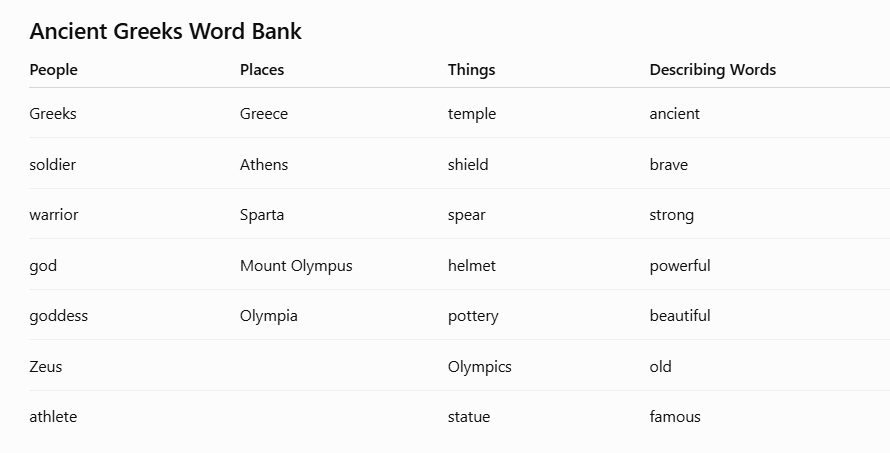
- The Ancient Greeks lived a very long time ago. They lived in a country called Greece.
- The Ancient Greeks lived in different cities. Two famous cities were Athens and Sparta.
- The Greeks believed in many gods and goddesses. They believed that Zeus was the king of the gods.
- The Ancient Greeks built beautiful temples. One famous temple is called the Parthenon.
- Greek soldiers sometimes carried shields and spears. Soldiers from Sparta were famous for being strong warriors.
- The Ancient Greeks started the Olympic Games. The games included running, wrestling and other sports.
- The Ancient Greeks also enjoyed stories, plays, music and art. We can still see some of their pottery and buildings today.
Introduction – What does belonging mean?
Today we are thinking about a very important word: belonging.
Belonging means feeling that you are part of something, that you are accepted and that you matter. We all belong to different groups, and each one helps us understand who we are.
Question: What does it feel like when you know you belong somewhere? Take a few answers, such as happy, safe, welcome or included.
Today, we will think about three places where we belong: our families, our school and our nation.
- Belonging to a family
Families come in all different shapes and sizes. Some children live with one parent, some with two, some with grandparents, foster carers or other people who care for them. Some families are big and some are small. What matters is the love, care and support we give one another.
In a family, we can show belonging by listening, helping, sharing and making sure everyone feels valued.
Question: What is one thing you can do to help someone in your family feel that they belong?
The UN Convention on the Rights of the Child, or UNCRC, reminds us that children have the right to be cared for and to have their family relationships respected. Article 5 recognises the important role of parents and carers, while Article 9 protects children’s relationships with their parents where it is safe and in their best interests.
- Belonging to our school
Our school is another community where we belong. We may have different interests, languages, beliefs and backgrounds, but we are all important members of the same school.
Belonging does not mean we all have to be the same. It means we respect our differences and make sure nobody is left out.
Question: Imagine a new pupil joins our class tomorrow. What could we do to help them feel welcome?
This connects to Article 12 of the UNCRC, which says children have the right to express their views and be listened to, and Article 28, which recognises every child’s right to education.
It also connects to the British values of mutual respect and tolerance. We show these values when we listen to others, celebrate differences and treat everyone fairly.
- Belonging to a nation
We also belong to a nation. We may feel connected to Britain, England, another country, or more than one nation. Our national identities can be different, and each person’s identity deserves respect.
Living together in a nation means sharing responsibilities and helping our communities. We can belong while having different cultures, religions, opinions and traditions.
The British values help us understand how to live together:
- Democracy: Everyone should have a voice.
- The rule of law: Rules and laws help protect people and keep us safe.
- Individual liberty: We have freedom to make choices while respecting others.
- Mutual respect and tolerance: We treat people with dignity, even when they are different from us.
Question: How can we show respect to someone who has a different belief or tradition from our own?
Article 8 of the UNCRC protects a child’s identity, including their nationality, and Article 30 recognises the rights of children from minority communities to enjoy their culture, religion and language.
- Reflection and closing
Belonging is not just about being included ourselves. It is also about helping other people feel included.
Think quietly about these three questions:
Who helps me feel that I belong?
Who might need a little more kindness or friendship today?
What one action can I take to help someone feel welcome?
This week, our challenge is to notice someone who might feel left out and do one small thing to include them. It could be inviting them to play, listening to their ideas or simply saying hello.
Remember: We may belong to different families, schools and nations, but every child has the right to feel respected, valued and included.