


Wednesday 24th June

Wednesday 24th June 2026
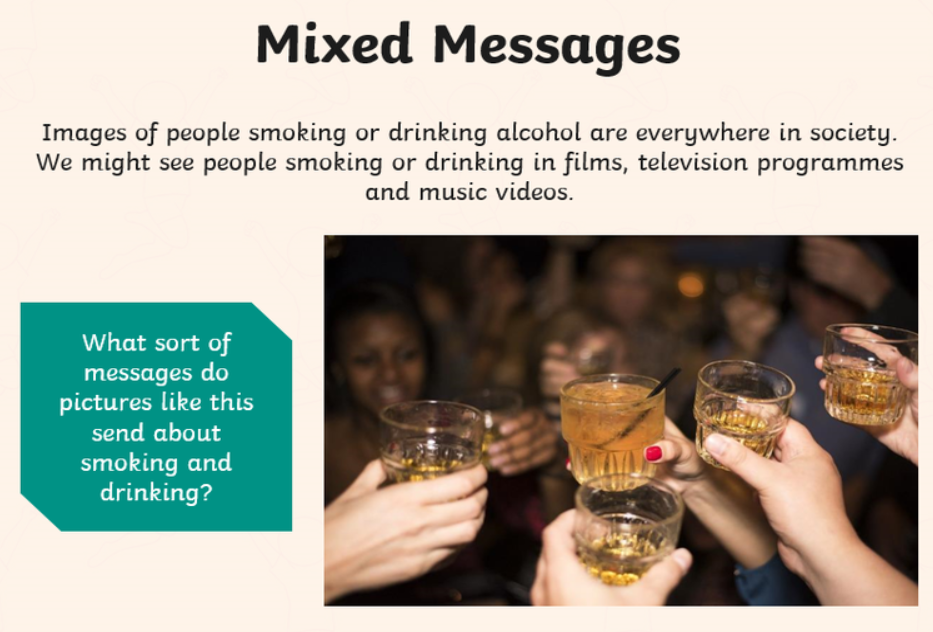
LC: To explore the mixed messages in the media about drugs.
/i/video/Year_3/Hendricks_Video_-_Mixed_Messages.mp4
Talk Partners
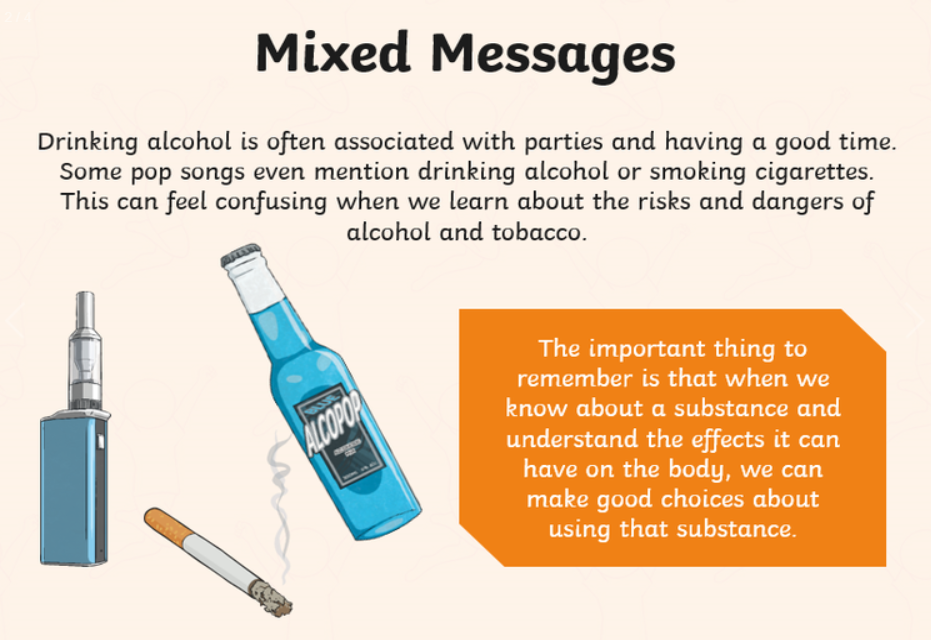
Is this a happy video? Is it exciting?
Do you think the advert will make people want to buy alcohol?
Look at the image below.
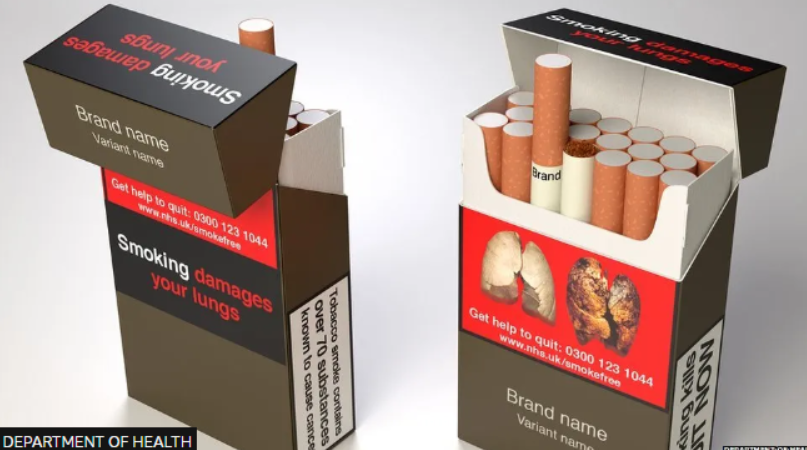
Look at the front of the packet. What does it show?
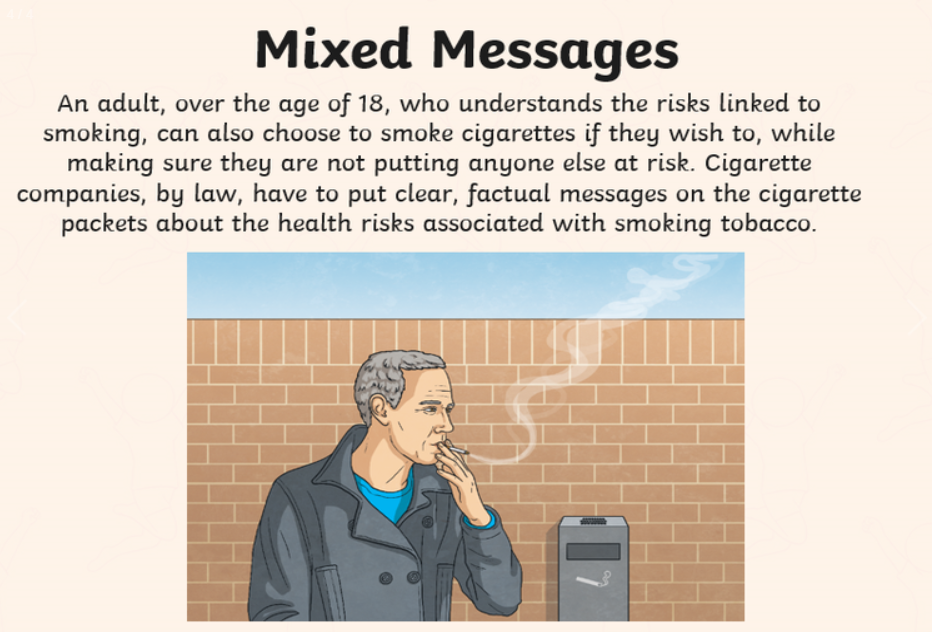
Have you ever seen an advert advertising smoking?
Activity
In a group of four you will create an advert which will make people NOT want to smoke or drink.
You might want to mention the health risks!

LC: To select and effectively use subordinating conjunctions
Talking partners
Take turns to orally compose sentences which include subordinating conjunctions from the list below. The sentences can be linked to the Spider and the Fly or be something associated with the classroom.
When , if, because, although, while, since, until, before, after, as.
Don't forget, you can add the subordinating conjunction at the start or in the middle of your sentence.
For example:
Before the spider began to spin his web, he cleared his pantry. (Why have I used a comma at the start of this sentence?)
The spider cleared his pantry before spinning his web.
Here are some sentences that you could add the subordinating conjunctions to:
The fly flew...
....the fly looked up at the winding stair...
The spider ate...
LC: To discuss and record ideas for planning.
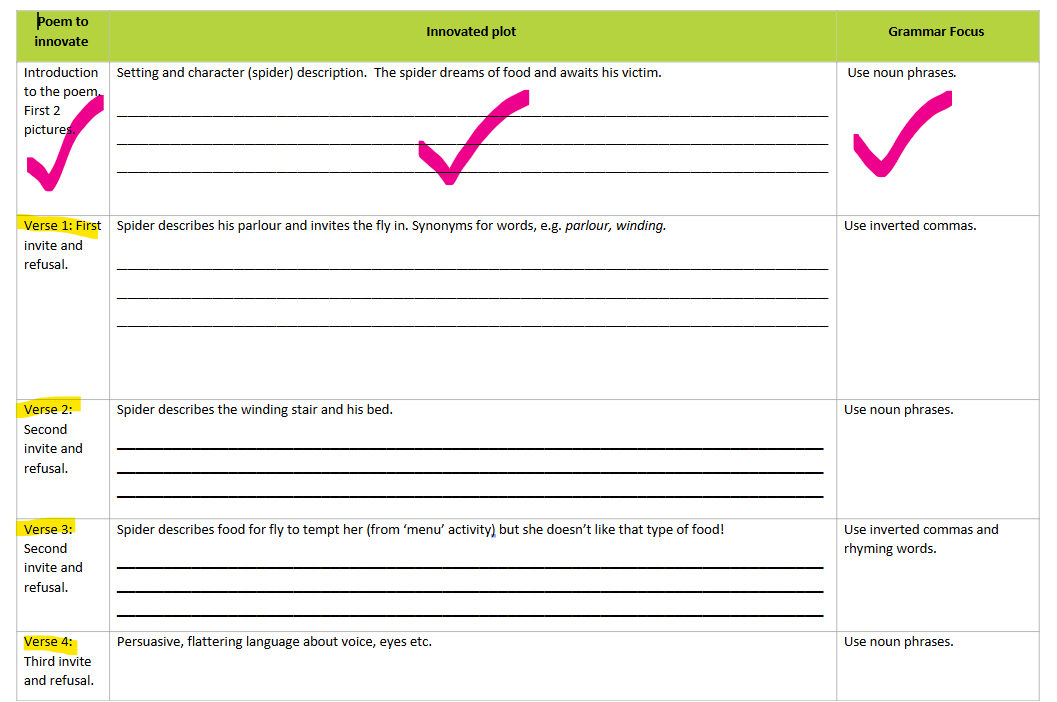
Now that we completed the planning for our prologue and added ideas for the description of the house, spider and the daydream. We are now ready to go back to our table and begin the planning for the story.
Look at the yellow highlighted boxes. Today, we will plan what we will write for verses 1-4.
We have already completed the first box.
Verse 1:
We are using the poem and changing some words...
"Will you walk into my parlour?" said the spider to the fly;
"'Tis the prettiest little parlour that ever you did spy.
The way into my parlour is up a winding stair,
And I have many curious things to show when you are there."
"O no, no," said the little fly, "To ask me is in vain,
For who goes up your winding stair can ne'er come down again."
For example:
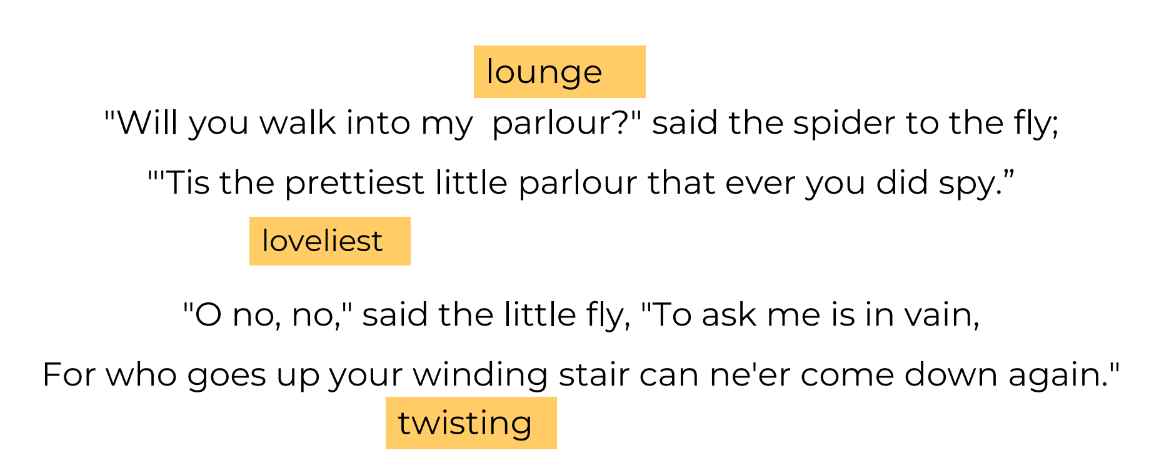
In your plan write down the words that you like to change.
Verse 2:
"I'm sure you must be weary, dear, with soaring up so high;
Will you rest upon my little bed?" said the spider to the fly.
"There are pretty curtains drawn around, the sheets are fine and thin,
And if you like to rest awhile, I'll snugly tuck you in."
"O no, no," said the little fly, "for I've often heard it said,
They NEVER, NEVER WAKE again, who sleep upon YOUR bed."
What words can we change?
Add them to your plan.
Verse 3:
Said the cunning spider to the fly, "Dear friend, what shall I do,
To prove the warm affection I've always felt for you?
I have within my pantry good store of all that's nice;
I'm sure you're very welcome; will you please to take a slice?
"O no, no," said the little fly, "kind sir, that cannot be;
I've heard what's in your pantry, and I do not wish to see."
What words would you like to change here?
Add them to your plan
Verse 4:
"Sweet creature!" said the spider, "you're witty and you're wise,
How handsome are your gauzy wings, how brilliant are your eyes!
I have a little looking-glass upon my parlour shelf,
If you'll step in one moment dear, you shall behold yourself."
I thank you, gentle sir," she said, "for what you're pleased to say,
And bidding you good-morning NOW, I'll call ANOTHER day."
Add the changed words to your plan.
24.06.26
LC: To recognise 3D shapes in different orientations.
Take a look at these common 3D shapes and their properties:

Sphere
Balls are shaped like a sphere.
Properties:
- 1 curved face
- No vertices
- No edges

Cube
Dice and sugar cubes are shaped like cubes.
Properties:
- 6 faces (all shaped like squares)
- 12 edges
- 8 vertices
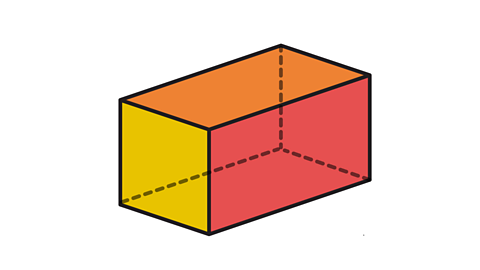
Cuboid
Fridges and wardrobes are usually shaped like cuboids.
Properties:
- 6 faces (all rectangular, or a mixture of rectangles and squares)
- 12 edges
- 8 vertices
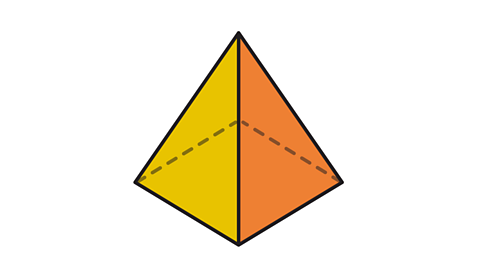
Square-based pyramid
The pyramids in Egypt look like square-based pyramids. They are called square-based pyramids because the face on the bottom is a square.
Properties:
- 5 faces (1 square and 4 triangular)
- 8 edges
- 5 vertices
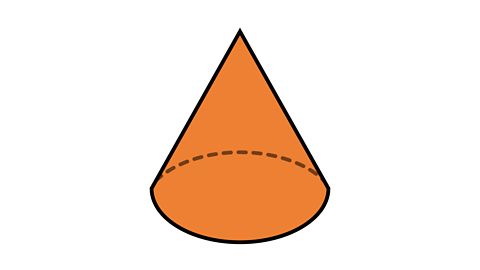
Cone
Ice cream cones, traffic cones and birthday hats are shaped like cones.
Properties:
- 2 faces (1 circular at the base and 1 curved)
- 1 edge around the base
- 1 vertex

Cylinder
These look like tubes and toilet rolls.
Properties:
- 3 faces (2 circular and 1 curved)
- 2 edges
- 0 vertices
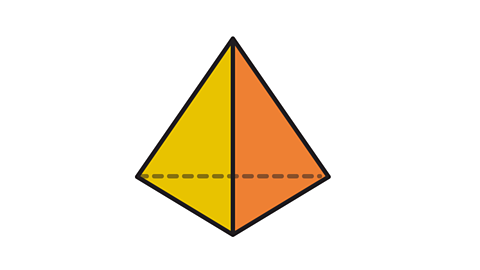
Triangular-based pyramid
A triangular-based pyramid.
Properties:
- 4 faces (all triangular)
- 6 edges
- 4 vertices
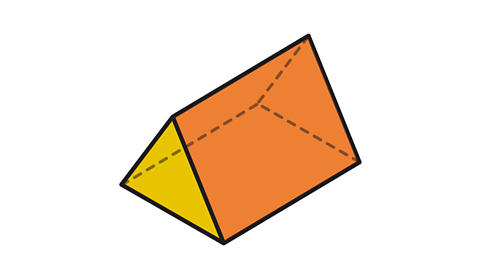
Triangular prism
Door stops and tents are examples of triangular prisms.
Properties:
- 5 faces (2 triangular and 3 rectangular)
- 9 edges
- 6 vertices
Activity
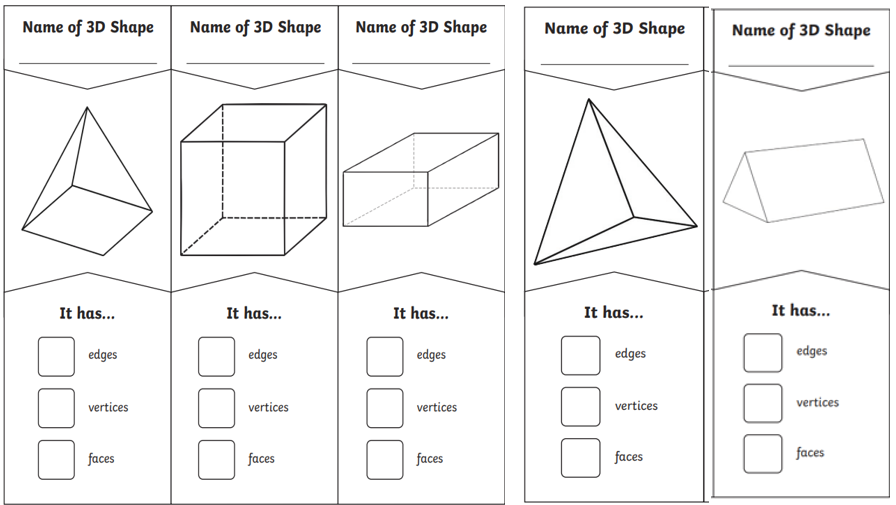
Now complete your Freckle task!
RIC
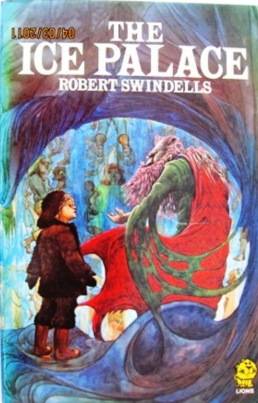
The snow was deeper now and Ivan’s feet sank far beneath the surface with every step. He began to feel tired and to wonder if he would ever see his home again. He was thinking longingly about his chair by the big, hot stove, when there came a sound that felt like an icicle in his heart. It was the long, thin cry a hungry wolf makes when it scents its prey. The cry was answered by another, and soon the pinewood echoed with the howls of the hunting pack.
R - Where is Ivan?
I - Why is Ivan missing home?
C- Why has the author used the word icicle to describe the sound that came?
Wednesday 25th June 2025.
LC: To infer characters thoughts from their actions.
Previously in Reading, we have learnt about inferring characters feelings from their actions. Can anybody remember what inference means?
Inferring is a bit like being a detective. You have to find the clues to work out the hidden information.
Today, we are focusing on characters thoughts from their actions.
We are not looking at feelings.
For example:
Let's take a look at some scenarios together:
The police are investigating a bank robbery. I walk past them and hundreds of bank notes fall from my bag. They ask me where the money has come from. What am I thinking?

I will be thinking...
Now, let's take a look at a short clip together...
We will only watch it up to 1 minute.
/i/video/Itrat_Ali/Summer_2/Reading/Week_4/Wednesday/Catch_It_-_ESMA_2015.mp4
Now, let's collectively think, what the meerkats are thinking...
I think the meerkats are thinking...
because...
Now continue watching the clip to 1.34 seconds.
Speak to your talk partners and discuss what you think the Vulture is thinking.
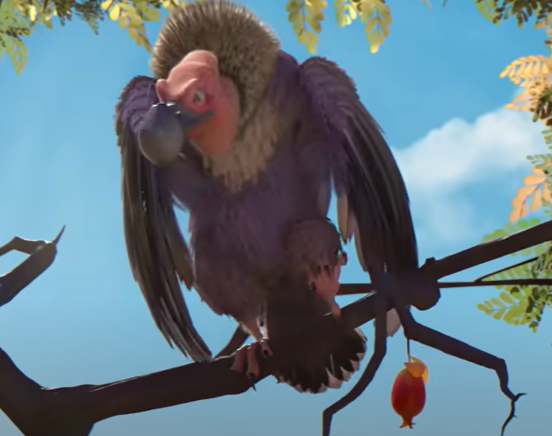
Let's create a sentence together:
I think the vulture is thinking...
because...
Now continue watching the clip to 1:45 seconds.
On your white boards write down what you think the meerkats are now thinking.
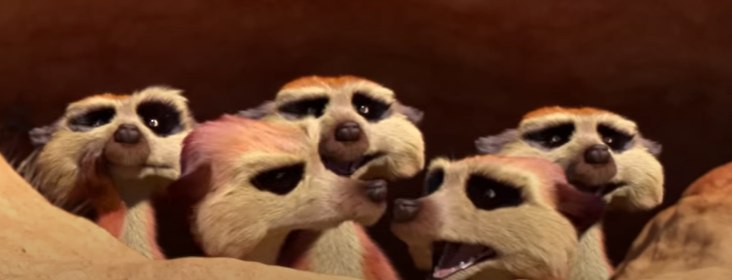
I think the meerkats are now thinking that...
because...
Watch the remainder of the clip.
Independent
You are now going to watch a short clip called The Light House.
Your teacher will play it for you up to 0.45 seconds.
/i/video/Itrat_Ali/Summer_2/Reading/Week_4/Wednesday/Lighthouse__Animation_.mp4
What do you think the old man is thinking?
I think that the old man is thinking....
I know this because...
Your teacher will now continue the clip up to 1.05 seconds.

Now what do you think the old man is thinking?
I think that the old man is thinking...
because...
Now enjoy the rest of the clip!

Wednesday 24th June 2026
LC: To suggest how belief in the Holy Spirit as God’s presence in the world might have an impact on individuals and communities.
/i/video/Year_3/Holy_Spirit_Wind.mp4
/i/video/Year_3/Holy_Spirit_Flame.mp4
/i/video/Year_3/Holy_Spirit_Dove.mp4
-
What do you notice about these symbols?
-
How do these things make people feel?
-
Why do you think Christians use these symbols for the Holy Spirit?
Christians believe the Holy Spirit is part of God — a helper, guide, and comforter.
In the Bible (Acts 2), the Holy Spirit came to Jesus’ friends at Pentecost and gave them courage and strength.
Christians believe the Holy Spirit helps them today — giving peace, strength, and love.
Talk Partners
How might someone feel if they believe God is always with them?
What kind of things might they do?
Activity
In pairs or small groups, act out a scene where someone is helped by the Holy Spirit. E.g.,
- Someone scared to speak up for someone else
- A community helping others after a storm
- A person forgiving someone after being hurt
Performance Time!
What kind of changes might we see in a person who believes the Holy Spirit is with them?
How might a whole community act differently because of this belief?